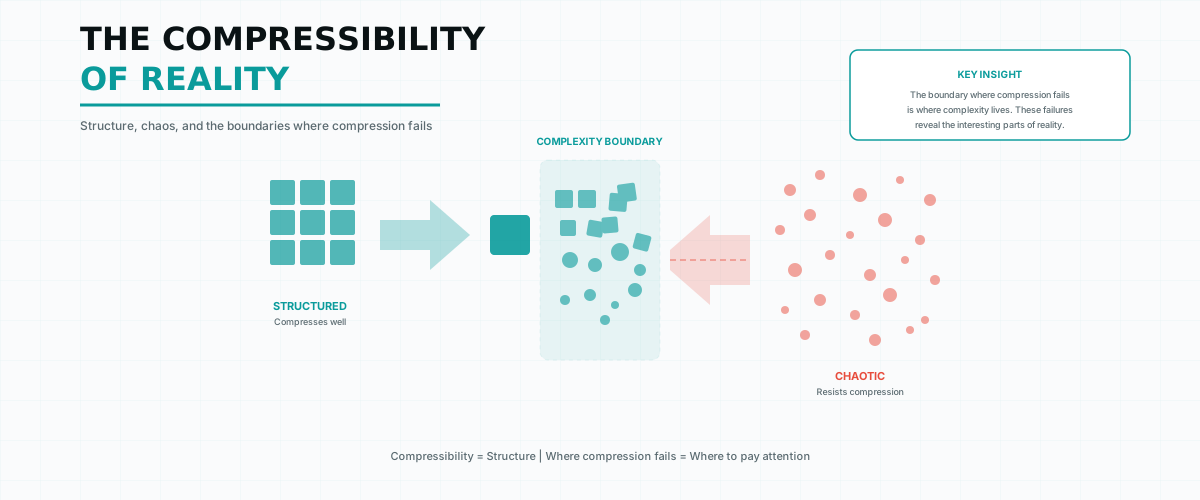
Abstract: In information theory, compressibility is a proxy for structure. But what if compressibility is a property of reality itself? The places where compression fails are where complexity lives. This essay explores how buildings, surfaces, and human behavior create regimes of varying compressibility, and why monitoring these boundaries may be the key to understanding complex systems.
In information theory, compressibility is a proxy for structure. A random signal resists compression. A structured one yields to it. The more regularity, repetition, or pattern a signal contains, the smaller it can be made without losing meaning.
This idea has been extraordinarily successful in computing. Text compresses well because language has grammar. Images compress because the world has edges and continuity. Video compresses because motion is correlated across time. Neural networks work, in part, because the world is compressible enough for models to exploit.
What if compressibility extends beyond data.
What if it is a property of reality itself.
And what if the places where compression fails are the most interesting parts of the system.
This essay explores that possibility.
1. Compression as a Lens on the World
Physics has always searched for compression. Laws are compressions of observation. Equations summarize entire classes of phenomena. Thermodynamics compresses the chaos of molecular motion into a handful of variables. Statistical mechanics turns astronomical state spaces into tractable descriptions.
In each case, success depends on a hidden regularity. Many microstates behave similarly enough that they can be treated as one. The world cooperates by being redundant.
But that cooperation is uneven.
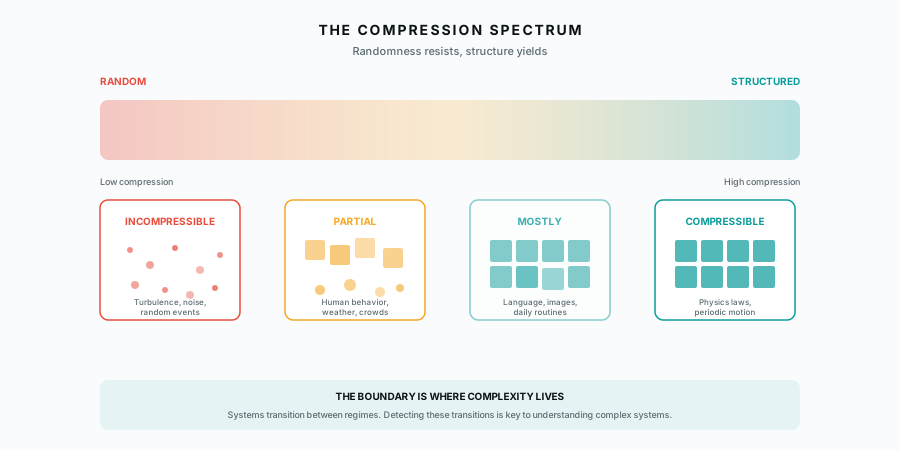
Some parts of reality compress beautifully. Planetary motion. Elastic deformation. Diffusion. Others resist compression stubbornly. Turbulence. Earthquakes. Weather at long horizons. Human behavior.
The boundary between compressible and incompressible regimes is where complexity lives.
2. Compression Failure as Signal
In classical chaos theory, small perturbations lead to large divergences. Prediction fails when rules amplify uncertainty faster than measurement can keep up.
Compressibility offers a complementary view.
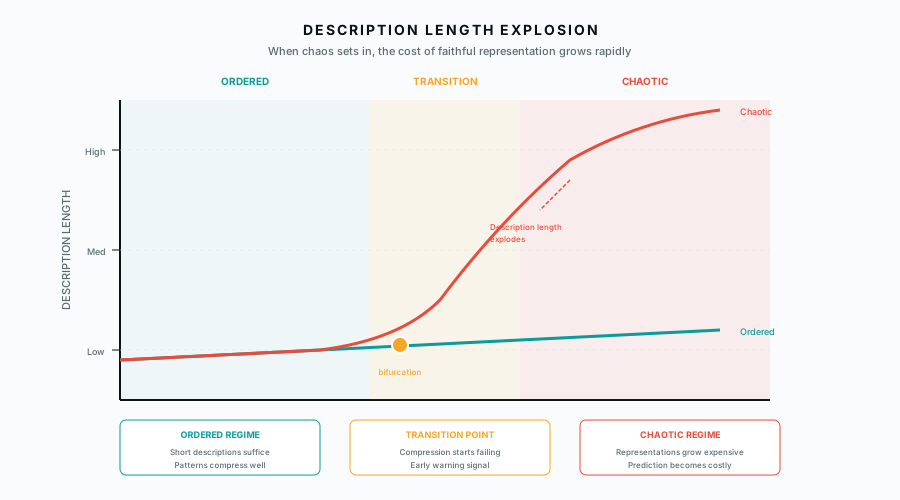
A system becomes hard to predict when it stops compressing well. Patterns fragment. Correlations decay. Representations grow longer instead of shorter. Any attempt to summarize the system without losing fidelity becomes expensive.
From this perspective, chaos encompasses more than sensitivity to initial conditions. It includes a collapse in representational efficiency.
The description length explodes.
This suggests a reframing: instead of asking whether a system is predictable, we can ask how compressible it remains under observation.
3. The Built World as a Compression Engine
Buildings function as dynamic compression machines.
They compress movement into corridors. They compress choice into paths. They compress social interaction into zones. They compress energy into flows and gradients.
When people move through a building, they generate trajectories that are highly redundant. Most footsteps follow similar routes. Most pauses happen in similar places. Most deviations cluster around the same obstacles, thresholds, or affordances.
This is why movement is compressible at all.
But compression is not uniform.
Certain areas behave like smooth manifolds. Others behave like noise sources. A hallway during a quiet afternoon compresses easily. The same hallway during an evacuation, a shift change, or a disruption becomes far less compressible.
The building stayed the same while the compressibility of reality inside it shifted.
4. Surfaces as Compression Boundaries
Much of this shift happens at surfaces.
Floors, walls, thresholds, handrails, pavements, and stairs are where intention meets resistance. They translate force into motion, friction into delay, geometry into choice. They act as filters that amplify some behaviors and dampen others.
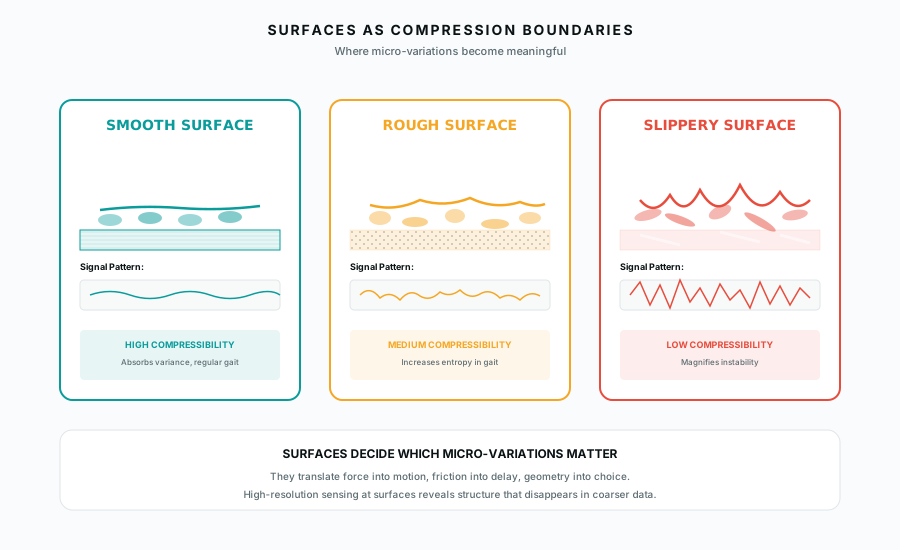
From an information standpoint, surfaces decide which micro-variations matter.
A rough surface increases entropy in gait. A compliant surface absorbs it. A slippery surface magnifies instability. A patterned surface creates periodicity.
Surfaces shape the compressibility of motion.
This is why high resolution sensing at surfaces reveals structure that disappears in coarser data. The surface is where information is created and destroyed, making these variations meaningful rather than merely noisy.
5. Human Behavior and Partial Compressibility
Human behavior sits in an uncomfortable middle ground. It is neither random nor fully rule-bound. It compresses partially.
Daily routines compress well. Commutes. Work shifts. Meal times. Habitual paths. But novelty, stress, fear, fatigue, and social interaction inject new degrees of freedom.
The result is a system with mixed compressibility.
Large scale patterns emerge reliably. Fine scale details resist summarization. Attempts to model behavior that assume uniform compressibility either overfit or wash out exactly the signals that matter.
This tension shows up everywhere. In traffic modeling. In crowd safety. In public health. In security. In rehabilitation. In urban planning.
The mistake is often the same: assuming the world remains equally compressible across regimes.
It does not.
6. A New Kind of Chaos Boundary
Classic chaos theory focuses on sensitivity to initial conditions. The lens of compressibility suggests another boundary.
Some systems fail because small errors grow. Others fail because the shortest faithful description grows faster than we can track.
In this view, transitions matter.
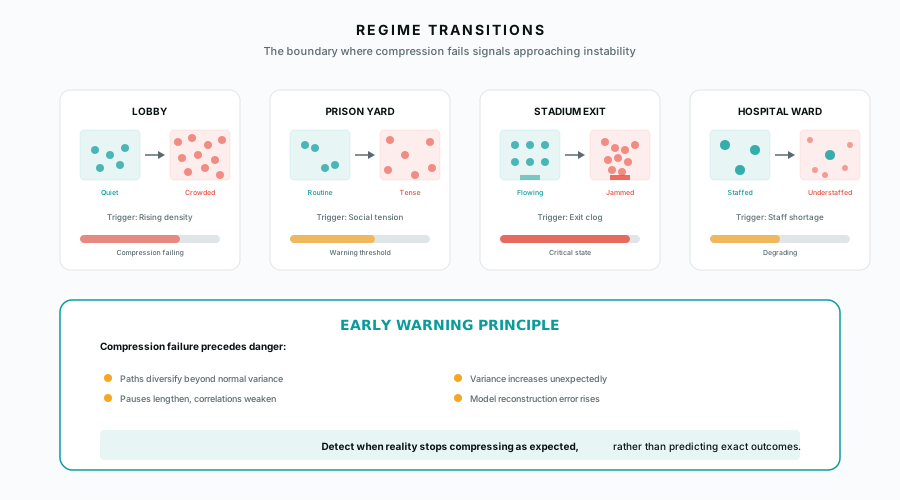
A lobby shifts from compressible to incompressible as density rises. A prison yard shifts regimes as social tension increases. A stadium shifts regimes when exits clog. A hospital ward shifts regimes when staffing drops below a threshold.
A loss of compressibility often precedes the onset of danger, even without obvious events. Paths diversify. Pauses lengthen. Variance increases. Correlations weaken.
Entropy rises, but in a structured way.
If this framing holds, then early warning requires detecting when reality stops compressing as expected, rather than predicting exact outcomes.
7. Measurement as a Test of Compressibility
Sensing systems implicitly test compressibility all the time.
When a model trained on normal conditions starts to struggle, it is often because the data has become less compressible under the same representation. Reconstruction error rises. Latent spaces fragment. Confidence drops.
These model failures double as signals about the world.
In physical environments, high resolution sensing of movement, pressure, and flow makes this visible. You can watch compressibility degrade spatially and temporally.
A corridor that once behaved like a single flow splits into competing streams. A waiting area loses its rhythm. A path that once absorbed variance begins to amplify it.
This is a measurable change in informational structure.
8. Implications
If compressibility is a property of reality, not just data, several implications follow.
First, prediction should be framed as conditional on compressibility. Not all regimes deserve the same confidence.
Second, intervention should aim to restore compressibility, not control outcomes. Adjusting surfaces, layouts, lighting, staffing, or access can lower entropy without micromanaging behavior.
Third, intelligence may live at boundaries. At the interface where compressibility changes, where structure breaks down, where new degrees of freedom appear.
This suggests a different role for sensing and computation. Less oracle. More observer of representational health.
Closing Thought
The world is unevenly compressible.
Some parts fold neatly into models. Others resist, fragment, and spill information faster than we can contain it. Those failures are where reality is telling us something important.
A future theory of complex systems may center on monitoring how compressible the world remains, where it fails, and how surfaces, environments, and interventions reshape that boundary.
Chaos, in this light, encompasses more than sensitivity.
It marks the moment reality stops fitting into the boxes we built for it.
Understanding that moment may be the beginning of a new science.