
Abstract: Crowds look chaotic from the inside. From above, patterns form: lanes emerge, vortices appear around obstacles, density rises and falls like a tide. Treating crowds as thermodynamic systems that process entropy offers a new lens for understanding collective motion. The question is simple and difficult: can we predict large-scale human flow by understanding the entropy landscape that groups collectively shape?
Crowds look chaotic from the inside. People bump, hesitate, speed up, shuffle sideways, stall at bottlenecks, pour through gaps. From above, it starts to look like something else entirely. Patterns form. Lanes emerge. Vortices appear around obstacles. Lines press into walls, then relax. Density rises and falls like a tide.
It is tempting to describe this with metaphors from fluid dynamics or traffic engineering. Cars on a highway. Water in a pipe. Flow in a channel.
There is another lens that is just as interesting. Treat crowds as thermodynamic systems that process entropy.
People are not molecules, yet their collective motion obeys constraints that often look physical: conservation of number, pressure buildup in narrow passages, gradients of density and desire, dissipation of energy through motion and noise.
In that view, a busy station, a stadium exit, or a prison yard is both a circulation problem and a constantly shifting entropy field that crowds push against and reshape.
The question is simple and difficult at the same time: Can we predict large-scale human flow by understanding the entropy landscape that groups collectively shape?
1. From Particles to People
Entropy, in the simplest physical sense, is a measure of how many microstates correspond to a macrostate. Many different arrangements of molecules can all look like "the same" temperature and pressure.
Crowds have a similar structure. A macro description might say:
- 700 people in the concourse
- average walking speed 1.1 m/s
- average density 1.5 persons per square meter
- 3 active exits
Within that macrostate, there are countless microstates. Each person has:
- position and velocity
- intent (catch a train, loiter, avoid someone)
- local constraints (strollers, bags, injuries)
- social links (families, groups, security staff)
Many different arrangements of these personal states can produce the same coarse picture when viewed from above. That is a kind of combinatorial entropy.
The difference from physics is that people have goals, perceptions, and learning. Their motion is "active" rather than passive. They expend effort to move away from discomfort, toward exits, toward friends, away from perceived threats.
That makes human crowds a kind of active matter system. Energy and information are injected through perception and decision, not just through temperature and random kicks.
Yet the analogy still holds: The more constraints you remove, the more ways the crowd can arrange itself. The more constraints you apply, the more narrow the set of possible configurations becomes.
Entropy is the size of that possibility set.

2. Gradients, Potentials, and Desires
In thermodynamics, systems evolve in ways shaped by gradients. Temperature gradients drive heat flow. Chemical gradients drive diffusion. Potential gradients drive motion.
Crowds move in gradients too:
- Exit signs and doors create potential wells.
- Narrow passageways create energetic costs in the form of discomfort and waiting.
- Security presence creates avoidance zones.
- Visual cues and sound create attraction or repulsion.
You can think of each person as feeling a subjective potential field. Part of it is physical (distance to exit). Part of it is social (distance to conflict). Part of it is psychological (desire to stay in the group, avoid isolation, stay within sight lines).
The "entropy of the crowd" then is shaped by these potentials:
- In a relaxed festival, many configurations have similar "comfort energy," so entropy is high and flows are diffuse.
- In a panicked evacuation, only a few configurations feel acceptable, so entropy is low and flows become rigid, locked into narrow channels that everyone is trying to occupy at once.
The physical environment matters. A concourse with many small exits offers more microstates for safe evacuation than a space with one massive, obvious exit that everyone rushes toward.
From an architectural point of view, the geometry defines the potential landscape. From a behavioral point of view, perception defines which parts of that landscape people notice.

3. Entropy as a Risk Surface
If you only count people, you miss important structure. A crowd of 500 can be calm or near critical. To see the difference, you need to track how ordered or disordered the motion is.
Some indicators that map naturally to "entropy":
- Variance of walking speed
- Diversity of directions in a local patch
- Frequency and size of sudden halts
- Rate of lane formation and lane breaking
- Amount of backflow (people reversing direction)
In quiet, orderly situations, many of these indicators sit within narrow bands. The motion is neither perfectly ordered nor purely random. People follow implicit rules: keep distance, avoid collisions, follow the flow.
As tension rises, patterns change:
- Speed distribution develops fat tails. Some run, others freeze.
- Directionality fragments. Instead of a single dominant flow, multiple competing flows appear.
- Backflow increases, as people realize a previous plan will not work.
- Micro-clusters form around incidents or perceived threats.
These changes can be summarized as rising entropy in the movement field. Not because someone computed Boltzmann's constant over a crowd, but because the number of possible motion patterns consistent with "what people are trying to do" increases rapidly.
In that sense, entropy is a risk surface. When the crowd explores too much of the configuration space too quickly, your margin for safety shrinks. The system has more ways to become unstable.
4. A Prison Yard Thought Experiment
Consider a prison yard.
On a quiet day, movement is structured. People follow known routines: exercise, small clusters, familiar paths to and from doors. Guards have reliable sight lines. The entropy of motion is moderate and stable.
Now imagine a day where tension is high. Rumors circulate. Food quality has declined. A recent conflict between groups has created mistrust.
Early in the yard period, line configurations already look different:
- Groups spread more irregularly.
- Paths intersect at sharper angles.
- Individuals drift closer to boundaries or blind spots.
If you had high resolution spatiotemporal sensing in the yard, you could quantify these changes:
- Increase in the number of abrupt heading changes per minute.
- Higher variance in interpersonal distances.
- Growing density in areas that are usually sparse.
- Short bursts of localized clustering that appear and dissipate quickly.
You can treat these as signs of increasing entropy in the crowd's motion field. The system is sampling more of the space of possible configurations in a shorter time.
From a security perspective, this signals a loss of coherent patterns that normally anchor behavior. The system is approaching a phase where small perturbations can cascade. A single shove or object thrown can trigger a rapid reorganization.
In that sense, a riot is a phase transition. The crowd moves from one basin of attraction (routine yard behavior) into another (collective conflict), driven by accumulated tension and a noisy fluctuation.
If you wait until the transition is obvious, it is too late. If you can measure entropy early, you might get a window for de-escalation.

5. Crowds as Dissipative Structures
Non-equilibrium thermodynamics studies systems that maintain structure by dissipating energy. Examples include convection cells, chemical oscillations, and some patterns in fluid turbulence.
Crowds can behave similarly.
In a stadium after a game, for instance, people have a shared macro goal: leave. The system is far from equilibrium, full of stored "desire to move." The architecture channels that desire through corridors and gates. The crowd dissipates tension by moving and exiting.
If the exits are generous, the entropy peak is low and short. Many micro-paths resolve cleanly. If the exits are tight or some are blocked, the system spends more time in a high entropy state where many conflictual configurations are possible.
You can see lane formation as a kind of spontaneous order. When enough people move in parallel in one direction, others align, and the local entropy of directions drops. This order allows faster dissipation of the gradient: people exit more efficiently.
But this order is fragile. A single person moving against the flow increases local entropy. Enough such perturbations and the system devolves into jams where nobody moves efficiently. Energy cannot dissipate, and frustration climbs.
This pattern is familiar to anyone who has watched a jammed turnstile or a blocked escalator: the system wants to dissipate, but the geometry and behavior combine to trap it.
Treating crowds as dissipative structures gives you a different design question: How do we shape architecture and protocols so that crowds can dissipate tension quickly and safely rather than storing it in ways that lead to sudden failures?
6. Information Flow and Local Rules
Entropic descriptions can sound like blind physics, yet information and perception play central roles.
Two crowds with identical numbers and geometry can behave very differently depending on what information people have:
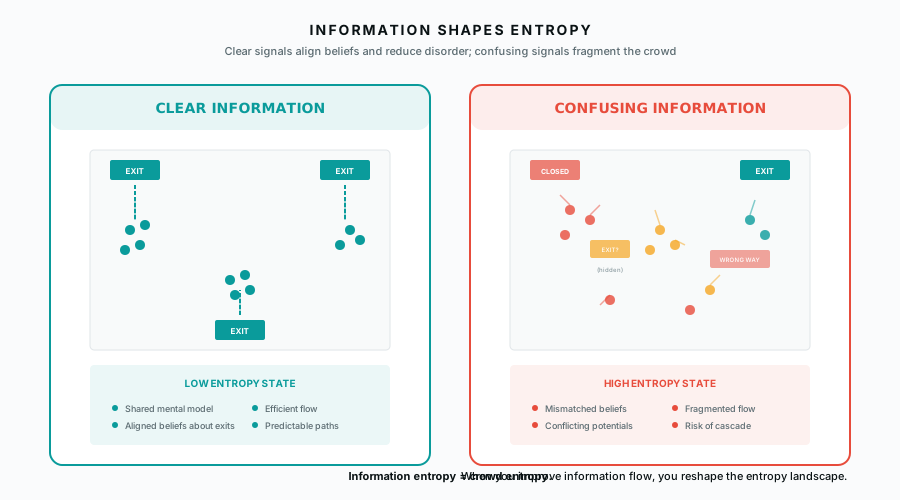
- Clear signage, visible exits, and consistent public address messages give everyone a similar potential field. Entropy is reduced by shared knowledge.
- Confusing signs, contradictory instructions, and hidden exits create mismatched potentials. Entropy increases, because groups pull in different directions.
From a modeling standpoint, each person has a Markov blanket: the set of variables they can sense and act upon. In a dense crowd, your blanket is small. You see nearby bodies, bits of wall, maybe a partial view of a sign. You infer the rest.
Local rules like "follow the person in front," "move away from pushing," or "head for light" produce global patterns when repeated across thousands of agents.
The entropy of the crowd is therefore also an information entropy:
- How uncertain are people about where to go?
- How inconsistent are their beliefs about what others will do?
- How noisy is the communication between them?
When you improve information flow, you reshape the entropy landscape. You move beliefs, and bodies follow.
7. Measuring Entropy in the Floor
Most of this has been conceptual. To use it, you need measurements.
In principle, a dense sensor grid in the floor of a station, stadium, or yard can reconstruct:
- trajectories of feet over time
- local densities and velocities
- zones of acceleration and deceleration
- micro-stops, stutter steps, and near collisions
From this, you can compute simple entropic measures:
- Distribution of heading angles in each patch over time
- Distribution of speeds
- Distribution of path curvatures
- Changes in these distributions compared to historical baselines
When these distributions broaden in ways that historical data associates with trouble, you have an early warning.
For example:
- A transit hub may learn that before a typical rush, entropy of headings rises briefly then stabilizes into dominant lanes. That is healthy.
- A rare pattern where heading entropy continues to rise, with growing density and backflow near certain gates, could signal dangerous crowding or panic.
The same infrastructure used to optimize layouts and staffing can also serve as a sensor for entropy changes that precede accidents or conflicts. The aim is observation of system-level stability, preserving privacy while detecting collective risk.
8. Predicting Without Dehumanizing
There is a moral risk in talking about the "entropy of crowds." It can sound like reducing people to particles that must be controlled.
The intent should be the opposite. A good entropy model respects the limits of human perception and behavior. It acknowledges that:
- there are physical limits on how tightly people can pack before danger rises sharply
- there are cognitive limits on what information a person in a crowd can process
- there are social limits on how people will respond under stress
By understanding these limits, you can design environments and procedures that reduce the likelihood of tragic configurations.
For instance:
- Prison administrators could adjust yard schedules, staffing, or space usage when entropy metrics suggest rising instability, rather than relying purely on anecdotal vigilance.
- Stadium operators could actively manage gate openings, signage, and announcements in response to entropic indicators, not just static crowd counts.
- Transit authorities could tune platform layouts and train timing to minimize time spent in high entropy configurations around narrow exits.
Prediction here means treating crowds as complex systems that deserve environments aligned with their physical and cognitive constraints.
9. Open Questions
Thinking about crowd entropy raises more questions than it answers:
- Can we define practical entropic measures that correlate reliably with risk across very different contexts, or will every venue need its own learned thresholds?
- How much forecasting is possible using only physical trajectories, without identity or personal data?
- Can we distinguish "good entropy" (creative exploration, healthy mixing) from "bad entropy" (rising instability, risk of crush or conflict) in a principled way?
- How should such systems be governed so that they support safety and dignity rather than becoming tools for over-control?
The science here touches non-equilibrium thermodynamics, active matter, and information theory. The practice touches architecture, crowd management, civil liberties, and ethics.
Closing Thought
Crowds are temporary systems that absorb desire, fear, information, and constraint, then express all of that as patterns of motion.
Entropy gives us a way to talk about how ordered or fragile those patterns are. High entropy crowds are not automatically dangerous, and low entropy crowds are not automatically safe. What matters is how quickly the system is changing and how close it is to configurations where small disturbances can cascade.
If we learn to see the entropy of human crowds, we gain a new kind of instrument. One that tells us when the collective is entering a regime where care, design, and attention matter most, even if it cannot predict what any individual will do.
We already instrument traffic and weather with this level of seriousness. Human movement deserves the same respect.