
Abstract: Digital systems like to pretend the world is clean. The physical world does not cooperate. Humidity swells materials, temperature cycles open micro-cracks, foam takes a compression set. This essay explores what happens when humidity, fatigue, and mechanical stress contribute more to error than ADC resolution ever will, and how to design sensing systems that survive reality.
Digital systems like to pretend the world is clean. Bits flip or they do not. Packets arrive or they drop. Latency is measured, logged, and shaved. When something goes wrong, the error is often discrete and diagnosable.
The physical world does not cooperate.
Humidity swells materials. Temperature cycles open micro-cracks. Foam takes a compression set and never fully rebounds. Adhesives creep. Conductive inks drift in resistance by a few percent here, a few percent there, until a calibration that looked perfect in the lab becomes a gentle lie in the field.
Sensors live inside that mess.
If you design sensing hardware as if it were a digital abstraction with a little Gaussian noise sprinkled on top, you get blindsided. If you accept that the real world has an error budget of its own, you can start to build systems that survive.
This is an essay about that budget.
It is about what happens when humidity, fatigue, and mechanical stress contribute more to your error surface than your ADC resolution ever will. And about what it means to design sensing systems that keep working even when the world refuses to hold still.
1. From Numerical Error to Material Error
When we think of "error" in computation, we usually picture numerical or algorithmic sources. Floating point precision. Quantization. Approximation in models. Maybe some sensor noise modeled as a nice symmetric distribution around a mean.
Physical error behaves differently.
Take a simple pressure sensor built into a floor tile. On paper, you budget error terms like this:
- ADC quantization
- electronic noise
- temperature coefficient of resistance
- calibration residuals
In a real installation, an entirely different cast of characters shows up:
- humidity that slowly changes the stiffness of foam or substrate
- temperature cycling that delaminates layers at the edges first
- compression set in the cushioning layer that shifts the baseline over weeks
- dirt, cleaners, shoes, wheels that load the system in patterns you never tested
- point loads that introduce local plastic deformation
None of these errors are nicely symmetric around zero. Many are directional and cumulative. They accumulate like tiny debts. The measurement you see is a combination of physics, aging, and abuse, not just electronics.
The measurement you see encodes history in what appears to be noise.

Figure 1: Digital error budgets assume clean, symmetric noise. Physical error budgets deal with humidity, compression set, and cumulative deformation: long-tail, directional, and history-dependent.
2. Humidity, Temperature, and the Slow Deformation of Truth
Environmental variables do not just add a jitter term. They change the underlying transfer function.
Humidity infiltrates polymers and foams and changes their modulus. The same load produces a slightly different strain. Temperature cycles expand and contract materials with mismatched coefficients. Over time, that produces micro-gaps, altered contact resistance, and mechanical fatigue.
For a large-area sensor, this plays out spatially:
- some zones see more sun, more heating and cooling
- some areas sit above ducts or cold slabs
- some edges are closer to exterior walls and see larger gradients
You end up with a sensor whose characteristics are not only time-varying, but location-varying across the surface. The calibration you did on a square sample in a controlled chamber is now being asked to cover a stadium of micro-environments.
Digital intuition expects that you can "just apply temperature compensation." The real world answers with a shrug and a buckling laminate.
3. Compression Set and Creep
Many sensing architectures use compliant layers. Foams, elastomers, flexible substrates. These materials do not experience load as a reversible event. Under sustained or repeated loads, they take a compression set. They creep. They change shape permanently.
That has two important consequences:
Baseline drift
A zone under a heavy display or a frequently used pathway develops a lower rest height. The sensor reads a different "zero" than before, even with no person present.
Non-uniform sensitivity
The relationship between load and response flattens or steepens differently in heavily used areas. Two points with the same real pressure can produce different readings because their mechanical histories diverged.
You can see this clearly in large-format flooring sensors that live through trade shows, hospitals, or airports. The spots where people queue, pivot, park carts, or place equipment start to behave differently from quiet areas. The error budget is not a single number. It is a map.
From a design perspective, compression set and creep are not rare edge cases. They are the normal end state of living under load.
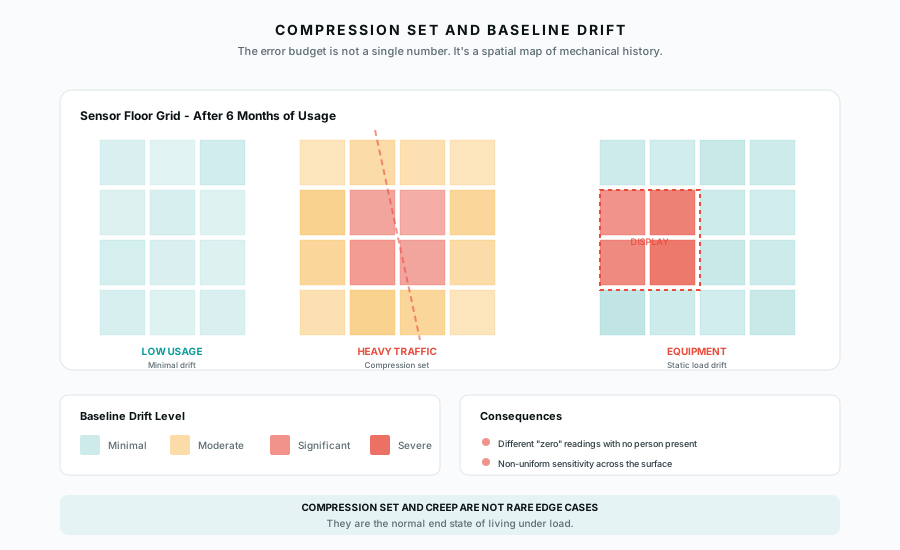
Figure 2: Three zones with different usage patterns develop different error profiles over time. The error budget is not a single number. It's a spatial map of mechanical history.
4. Noise That Is Not Noise
In textbooks, noise is often modeled as something like "additive white Gaussian noise." In the field, what you call noise is often an unmodeled variable.
Some examples:
- A cleaning cart with rigid wheels crossing a threshold at a certain speed creates a repeatable spike pattern.
- An oxygen tank dropped from a small height creates a ringing impulse in a region of the floor.
- A user with a tremor creates small high-frequency oscillations riding on a slower gait pattern.
- A wet shoe on a smooth surface creates a different contact patch than a dry one.
If your model was trained on "ideal" footfalls, these patterns look like noise. But they contain additional structure your representation has not learned to parse.
From a behavioral standpoint, the "noise" may even be the signal. For fall detection, rehabilitation, or senior living, the small irregularities matter as much as the gross movements. Mechanical reality injects structured randomness that is diagnostic, not just nuisance.
The error budget of the real world thus has a paradoxical feature: the part you are tempted to discard as noise often contains the most interesting information.
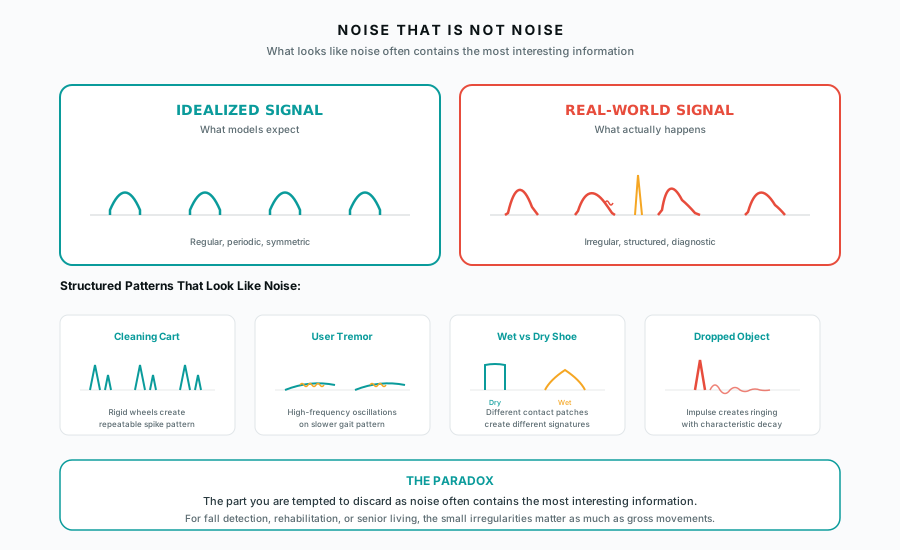
Figure 3: Real-world signals contain structured patterns that look like noise but carry diagnostic information. Cleaning carts, tremors, wet shoes, and dropped objects all create repeatable signatures.
5. Fatigue, Faults, and Long Tails
Digital errors tend to be local and obvious. A bit flip. A failed node. A crashed process.
Physical errors love the long tail.
Cracks grow subcritically under repeated stress cycles long before failure. Solder joints on flexing interfaces degrade slowly. Conductive traces printed on flexible substrates develop micro-fractures that only show up after thousands of small bending events.
From a sensing system point of view, that looks like:
- gradual increase in variance in one zone
- intermittent dropouts under certain loads
- rare misfires that cluster under specific environmental conditions
These are hard to catch with simple threshold-based health checks. The system appears fine right up to the moment of failure.
Traditional error budgets like to keep faults separate from noise. In practice, the two blend. Physical fatigue is just a slow walk toward an abrupt nonlinear event.
Building sensors for long-lived infrastructure means designing for that whole trajectory. Not just day-one accuracy, but year-five and year-ten survivability under repeated abuse.
6. Fault Tolerance in Physical Sensor Fabrics
Once you accept that the real world will bend, drift, and occasionally break parts of your sensor, the natural next question becomes: "What happens when some of them fail?"
That is where fault tolerance becomes a first-class design goal.
Large distributed sensor fabrics, like high resolution floors or wall panels, are not single instruments. They are meshes. Each sensing element covers a small patch of reality, and many patches overlap in function or context. Instead of treating every cell as a single point of failure, you can treat the fabric as an overconstrained system that can survive local damage.
A few patterns matter here:
Redundancy and overlap
If two or three neighboring cells can all see part of the same event, the system can reconstruct behavior even when one of them drifts or dies. Spatial redundancy lets you solve an inverse problem: infer the underlying pressure field from an imperfect set of measurements.
Graceful degradation
A digital system with a single failed server can crash in an instant. A physical sensor fabric should do the opposite. As cells weaken or fail, confidence degrades locally, not globally. The picture becomes slightly fuzzier in one region while the rest of the field stays sharp. Algorithms can learn to weight cells by health, uncertainty, and consistency with neighbors.
Mesh recovery and probabilistic reconstruction
With enough history, the system can learn priors over what reasonable patterns look like. If a cell goes dark, the model can interpolate from surrounding cells and from temporal patterns. It may not guess every detail, but it can recover enough to keep downstream applications working. You do not need perfect per-pixel fidelity if you can maintain a reliable field-level view.
In this sense, fault tolerance is a kind of social contract inside the sensor grid. No single element needs to be perfect. The fabric survives because elements cover for one another and higher-level inference knows how to live with partial information.
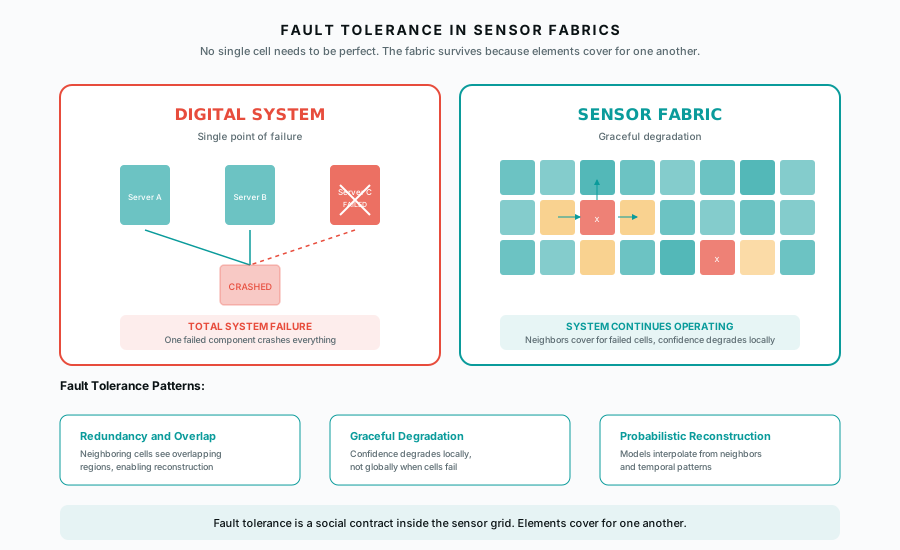
Figure 4: Digital systems crash when a component fails. Sensor fabrics degrade gracefully through redundancy, overlap, and probabilistic reconstruction. No single cell needs to be perfect.
7. Designing for Imperfect Realities
Acknowledging the real-world error budget demands a different style of engineering: designing systems with rigor that account for physical reality.
A few patterns tend to help:
7.1 Overlapping sensing and redundancy
Large surfaces with many sensing elements can be designed so that neighboring elements observe overlapping regions. That creates spatial redundancy. When one element drifts or weakens, inference can draw more heavily on its neighbors and on expected patterns of continuity.
7.2 Co-designed materials and algorithms
If you treat the sensor as a black box that outputs voltage, you lose options. If you design materials and algorithms together, you can choose mechanical stackups, adhesives, and printed inks that are less sensitive to known stressors, and then learn models that explicitly track slow variation.
For example, printed conductive traces and dielectric layers can be tuned for stable performance under humidity swings. At the same time, the software can maintain per-zone baselines that adjust slowly over time, separating transient events from slow drift.
7.3 Field calibration as a first-class process
Many hardware systems assume calibration as a one-time factory step. For sensors embedded in real environments, calibration must become continuous and opportunistic.
- Use naturally occurring events, like empty rooms at known times, as reference points.
- Exploit symmetries, like mirrored zones, to detect anomalies.
- Run self-check routines during off hours that gently stimulate the system and check its response.
The calibration protocol becomes part of the product, not an afterthought.
7.4 Embrace distributions, not constants
Instead of insisting that each sensor cell has a fixed response curve, model it as a distribution indexed by environmental variables and usage history. That means:
- keeping track of uncertainty explicitly
- acknowledging that some regions will always be fuzzier than others
- designing higher-level algorithms to tolerate that fuzziness
The goal becomes ensuring the system as a whole produces reliable inferences, even as individual components wander.
8. Human Intuition vs Physical Error
Humans have biases about physical error that mirror our biases about judgment. We over-weight clean stories and under-weight weird edge cases. We calibrate from short runs, not long histories. We generalize from ideal conditions to everyday reality without enough skepticism.
In lab tests, a new sensor design looks solid. In the field, you discover that:
- installers sometimes flex panels in ways you never imagined
- cleaners use solvents that seep into layers
- equipment loads a tiny area far beyond any test case
- a rarely used fire door slams hard enough to send a shock wave through your "quiet" region
The discrepancy runs deeper than technical assumptions: it reveals how we underestimate the ways buildings can surprise us.
Taking the real-world error budget seriously forces a kind of humility. You design as if entropy is a participant, not a background parameter.
9. Why This Matters for Intelligent Surfaces
As sensor grids move from prototypes into large-scale deployment inside floors, walls, and infrastructure, the error budget stops being an engineering curiosity and starts being a societal concern.
If you use sensing to:
- monitor senior mobility and detect falls
- optimize HVAC and reduce emissions
- instrument public spaces for safety and accessibility
- measure flows in hospitals, airports, and convention centers
then your error surface becomes part of the ethical surface. Missed events, biased regions, or drifting baselines translate into real consequences for people who move through those spaces.
The promise of intelligent surfaces is that they let buildings watch themselves in detail. The condition is that they must keep watching accurately even as humidity rises, temperatures swing, substrates creep, elements fatigue, and individual cells occasionally fail.
A clean environment is never guaranteed. Usable data must be earned inside a dirty one.
Closing Thought
Digital thinking encourages the belief that if we just choose the right sensor, the right converter, and the right architecture, the world will behave and the errors will cluster nicely around zero.
The real world offers a different contract. It offers slow deformation, uneven drift, long-tail failures, and noise that turns out to be structure in disguise. It also offers the chance to build fabrics that are resilient rather than fragile, systems that can lose pieces and keep going.
Designing sensors that thrive in that world means budgeting for error the way you budget for power or cost. It means treating humidity, fatigue, compression set, and local faults as first-class variables rather than footnotes. And it means building sensor fabrics that do something very human: share the load, tolerate imperfection, and still produce reliable insight.
The error budget of the real world will always be there. The question is whether we design with it in mind, or discover it the hard way, one silent drift and one failed cell at a time.