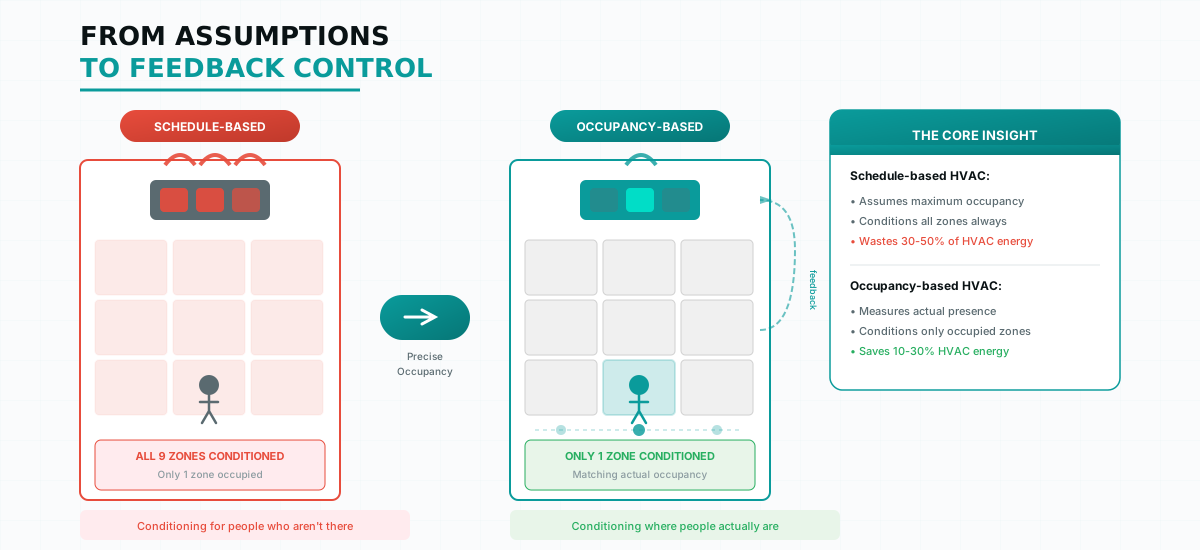
Abstract: Buildings consume about 40% of U.S. energy, with HVAC as a dominant lever. Most commercial buildings condition spaces based on schedules and assumptions, spending energy to maintain comfort for people who are not there. The fix is not smarter thermostats but a measurement upgrade: precise occupancy at the zone level, continuously, with enough spatial detail to run HVAC as feedback control. Studies show occupancy-based HVAC control commonly delivers 10-30% energy savings. This essay explores why motion sensors fall short, how precise occupancy closes the gap between belief and reality, and why floor sensing provides the signal HVAC was always meant to have.
Most commercial buildings heat, cool, and ventilate like they are mildly anxious.
They assume people are present unless proven otherwise. They keep air moving "just in case." They condition zones based on schedules written months ago, even when a floor is empty, a wing is closed, or a conference room has turned into an unused shrine of chairs and stale coffee.
The result is a simple kind of waste: spending energy to maintain comfort for people who are not there.
What changes the game is not "smart thermostats" or prettier dashboards. It is a measurement upgrade: precise occupancy.
Not motion detection. Not a binary "someone moved recently." Actual occupancy at the zone level, continuously, with enough spatial detail to run HVAC the way it was always supposed to run: as feedback control.
1. Why This Matters More Than People Realize
Buildings are one of the largest energy arenas in the U.S. The Department of Energy notes buildings consume about 75% of U.S. electricity and 40% of total energy. NREL similarly summarizes buildings as roughly 40% of U.S. energy use and a major share of electricity and emissions.
Inside buildings, HVAC is a dominant lever. For commercial buildings, the EIA breaks out space heating alone at about 32% of energy use (2018), with ventilation also a meaningful slice.
So when you improve HVAC control even modestly, you do not get a small win. You get a structural one.

2. Motion Sensors Are a Blunt Instrument
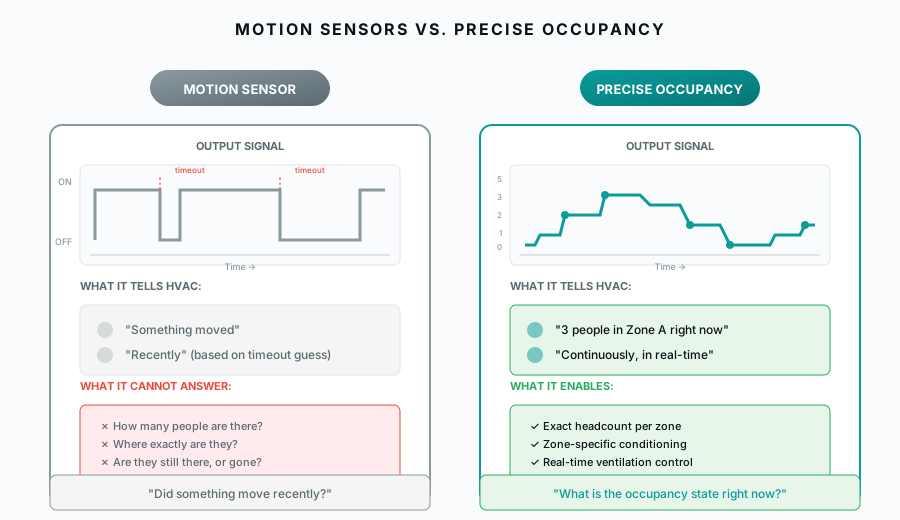
Motion sensors are good at one thing: detecting movement.
They struggle with everything we actually need for HVAC:
- How many people are present (one person vs forty changes ventilation demand)
- Where they are (conditioning the wrong zone is expensive)
- Whether they are still there (timeouts are guesses)
- What kind of occupancy it is (steady work, transient flow, dense queuing)
A motion sensor answers "did something move recently." HVAC needs "what is the current occupancy state of this space."
That gap is where most "occupancy-based" HVAC systems quietly lose their potential.
3. Precise Occupancy Turns HVAC from Schedules into Physics
Once you know occupancy continuously, HVAC becomes a solvable control problem:
Ventilation becomes demand-following
A major energy sink is conditioning outdoor air. Demand Controlled Ventilation (DCV), often using CO₂ as a proxy, is explicitly framed by ASHRAE as an energy-saving approach by adjusting outdoor air based on need.
Precise occupancy gives you an even more direct signal than proxy gases: the headcount and where it is happening.
Conditioning becomes zone-correct
Instead of cooling an entire floor because a single room is used, you can target the areas with real load. This sounds obvious, but "zone correctness" requires measurement.
Setbacks become aggressive without becoming risky
Most buildings run conservative setpoints because they fear discomfort complaints. With real occupancy, you can run deeper setbacks when empty and recover when people arrive, with much less guesswork.

4. The Simple Math of Waste
You can model a zone's HVAC energy in an intentionally simple way:
Where P(t) is HVAC power serving that zone. A crude but useful decomposition is:
- Pbase(t): baseline conditioning and minimum ventilation
- Pocc(t): incremental power attributable to people (ventilation, latent loads, sensible loads)
- ô(t): the building's internal belief about occupancy (0/1 for motion sensors, or a richer value for precise occupancy)
The waste shows up when belief diverges from reality:
A motion sensor's ô(t) is often "sticky" because of timeouts. That means ô(t) > o(t) for long tails of emptiness. The building keeps paying the occupancy premium after the humans have left.
The wasted energy has a shape:
- The bigger the gap (thinking "occupied" when it is not), the more waste.
- The longer the gap lasts (ten minutes vs two hours), the more waste.
- The more expensive the occupancy cost is in that moment (hot day, humid day, lots of outdoor air), the more waste.
Precise occupancy reduces the area under that error curve. Not by being fancier, but by being measurably closer to o(t).
The Plain-Language Version
Here is what that little block of equations is trying to say, without symbols.
1) HVAC energy is basically "how hard you run it" times "how long you run it"
If your system is pulling a certain amount of power at any moment, and you add that up across the day, you get total energy usage. So the fastest way to waste energy is simple: run the system hard when you do not need to.
2) HVAC power has two big pieces
Think of HVAC effort as having:
- A baseline cost: the minimum you tend to spend to keep a building stable and safe, even when it is empty.
- An occupancy cost: the extra energy you spend because people are present, mainly from bringing in and conditioning fresh air and dealing with body heat and humidity.
So the building's energy use climbs when it believes people are in a space.
3) The key variable is the building's "belief" about occupancy
The math used two versions of occupancy:
- Reality: how many people are actually there.
- Belief: what the building thinks is true, based on its sensors.
Motion sensors often create a belief that lingers. Someone walks through a room, the sensor trips, and the room gets treated as "occupied" for a while even after it empties. That is not malicious, it is how timeout-based logic works.
4) Waste happens in the gap between belief and reality
If the building thinks a room is occupied when it is empty, it keeps paying the occupancy cost for no benefit.
That wasted energy has a shape:
- The bigger the gap (thinking "occupied" when it is not), the more waste.
- The longer the gap lasts (ten minutes vs two hours), the more waste.
- The more expensive the occupancy cost is in that moment (hot day, humid day, lots of outdoor air), the more waste.
So you can picture "waste" as the area under a curve: the time spent conditioning for humans who are no longer there.
5) Precise occupancy shrinks that gap
Precise occupancy reduces wasted energy because it helps the building's belief track reality:
- It can tell when a space is truly empty, sooner.
- It can tell where people actually are, so it conditions the right zones.
- It can tell density, so it ventilates based on real demand instead of a guess.
The math was just a formal way of expressing a simple idea:
Energy waste is what you spend when your control system is acting on the wrong picture of reality. Better occupancy sensing makes the picture sharper, and the waste falls.

5. What Savings Look Like in Real Studies
Across multiple analyses, occupancy-based HVAC control commonly lands in the 10-30% HVAC savings band in the right settings.
- A DOE resource summarizing hotel guest rooms reports 10-30% HVAC energy savings on average for occupancy-based controls in that context.
- A 2022 study found PIR-triggered occupancy-based air control produced up to 18% electricity savings compared with typical time programs over the evaluated period.
- NREL work on occupancy-based control reports 1-20% HVAC energy savings depending on patterns and setbacks.
The important nuance is that "occupancy-based" is a family of approaches. The upper end of savings tends to appear when the occupancy signal is both accurate and actionable at the right spatial granularity.
6. Why Precise Occupancy Beats "Presence" for Decarbonization and Cost
Two buildings can have the same average occupancy and radically different energy outcomes depending on variance.
If people arrive in bursts, move in flows, or occupy only certain zones, the control system has to follow the distribution, not the average.
Presence sensors collapse a distribution into a single bit. Precise occupancy preserves enough structure to do three things well:
- Ventilate for actual demand
- Condition only the zones carrying load
- Recover quickly and confidently when patterns shift
That is the path to energy reduction that does not depend on behavior change campaigns or perfect schedules.
7. Where Floor Sensing Fits In
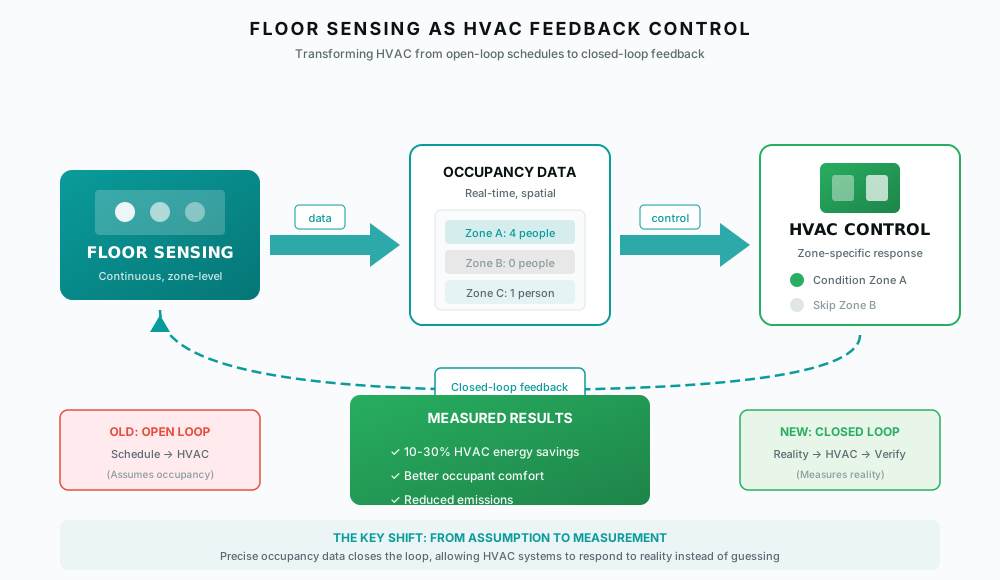
One reason we built high-resolution floor sensing at Scanalytics was that it naturally produces the kind of occupancy signal HVAC actually needs: continuous, zone-specific, and grounded in physical reality (bodies in space, not devices in pockets).
When you can measure occupancy with spatial fidelity, you can finally make HVAC responsive without making it fragile. That is the practical opportunity: better comfort, lower cost, and lower emissions, driven by measurement that aligns with how buildings are actually used.
Closing Thought
A lot of building energy waste is not caused by inefficient equipment. It comes from a mismatch between the control inputs we have and the world we are trying to control.
Precise occupancy fixes that mismatch.
It gives HVAC a trustworthy sense of "how many, where, and when," which turns a twentieth-century schedule machine into a twenty-first-century feedback system.
And in buildings, feedback is leverage.
References
- U.S. DOE, Buildings Sector Innovation: buildings consume ~75% of electricity and 40% of total U.S. energy.
- NREL (2023), U.S. buildings energy and emissions overview.
- EIA, end-use breakdown in U.S. commercial buildings (space heating ~32% in 2018).
- DOE resource (Dong), occupancy-based controls saving 10-30% HVAC energy in hotel guest rooms.
- Kitzberger et al. (2022), PIR-triggered occupancy air control savings up to 18%.
- NREL (2022), occupancy-based controls savings range 1-20% depending on patterns.
- ASHRAE addendum text referencing CO₂-based DCV as an energy-saving approach.